March 10, 2026
Corporate gala florals get handled badly more often than not. The event planner is focused on catering, AV, and seating charts; the florist gets a late brief, a fixed budget, and a vague instruction to "make it look nice." The result is usually a table of identical low arrangements in hotel-lobby colors that no one remembers and no one photographs. For companies that are spending real money on an event to honor clients, recognize employees, or launch an initiative, that outcome is a wasted opportunity.
Getting corporate event florals right requires a different kind of brief than a wedding and a different set of design decisions at the table level. Here is a practical guide to what works for Boston-area galas, what to avoid, and how to build centerpieces that serve the actual goals of the event.
Define the Room Before You Define the Arrangements
The most common mistake in corporate florals is designing arrangements in isolation without accounting for the venue. A centerpiece that works beautifully in a low-ceilinged function room at a boutique hotel will disappear in the soaring atrium of a Cambridge conference center. Before anything else, the florist needs to walk the room or, at minimum, review accurate floor plans and ceiling heights.
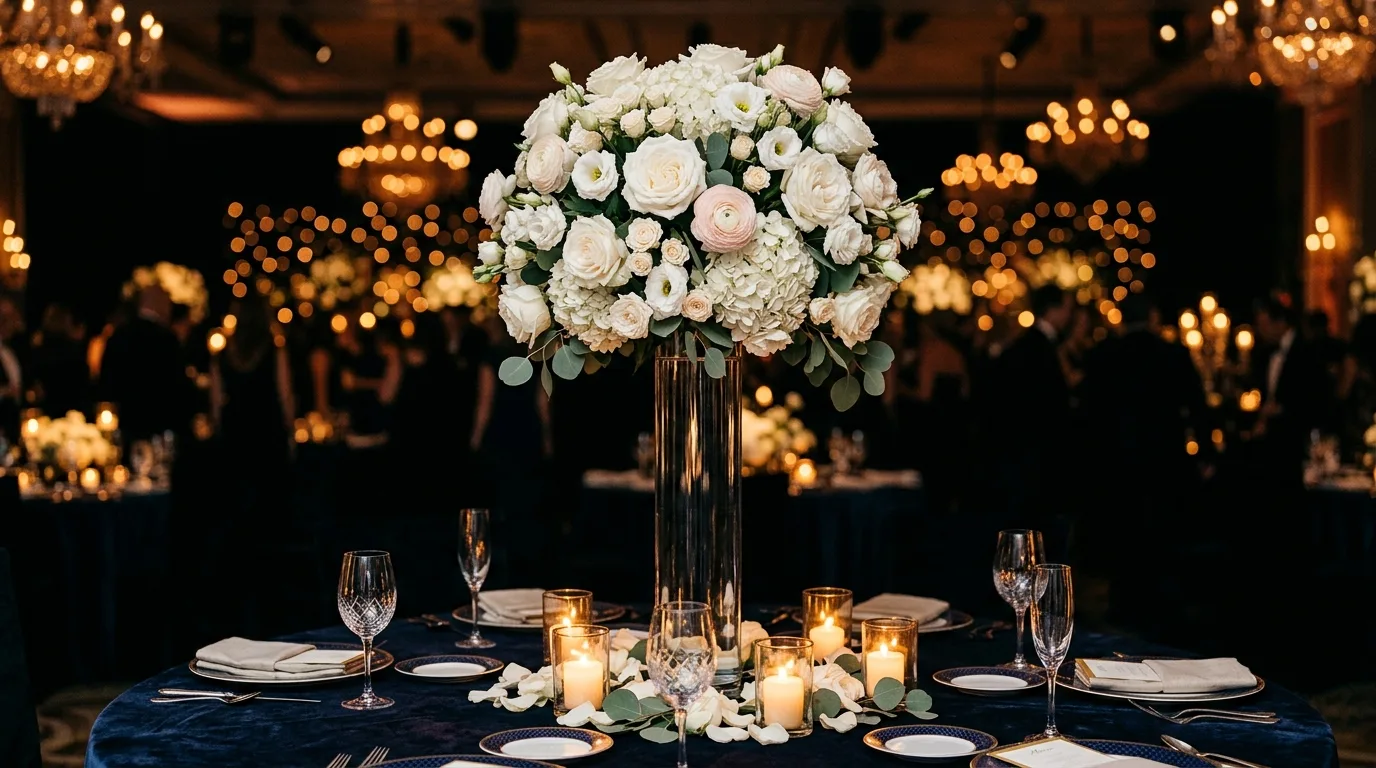
For rooms with high ceilings (above 14 feet), low arrangements read as furniture accessories rather than design statements. In these spaces, elevated centerpieces on tall clear-glass risers or wrought-iron stands bring florals into the sightline and give the room scale. Conversely, a formal dinner in a historic space with 9-foot ceilings and architectural detail calls for lower, denser arrangements that do not compete with the room itself.
Lighting is equally important. Candlelit venues favor arrangements with warm palette flowers that catch warm light and glow. Cool LED lighting, common in modern conference facilities, tends to flatten warm florals. In those spaces, white and green arrangements, or bold single-color statements, read more crisply.
Centerpiece Formats That Work at Scale
Corporate galas typically involve 15 to 40 tables. At that scale, design decisions get multiplied: a small visual problem in one arrangement becomes a consistent problem across the room.
The Column Arrangement: A tall, cylindrical vase or clear acrylic column supporting a mounded floral sphere above sightline. Flowers are typically placed in a dense dome of a single variety or two closely matched varieties. Below the column, low votive candles ring the base. This format works in virtually any venue with adequate ceiling height and is easy to execute consistently across 30 tables.
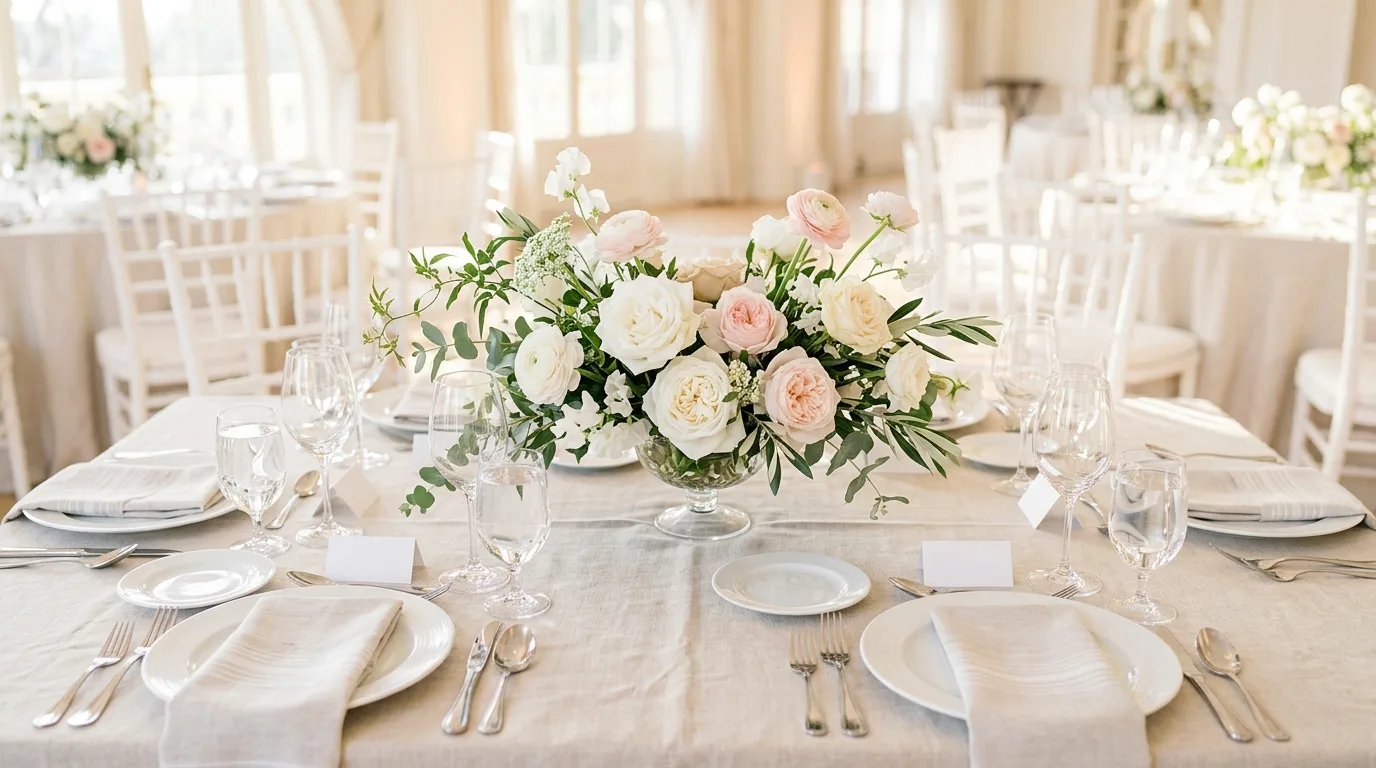
The Low Lush: Dense, overflowing arrangements in shallow compote vessels or low bowls. The key is volume. Mix textures aggressively: large focal flowers, secondary mid-size flowers, and textural elements like scabiosa pods and craspedia. For a gala with a sophisticated aesthetic, this format rewards investment in high-quality locally sourced varieties.
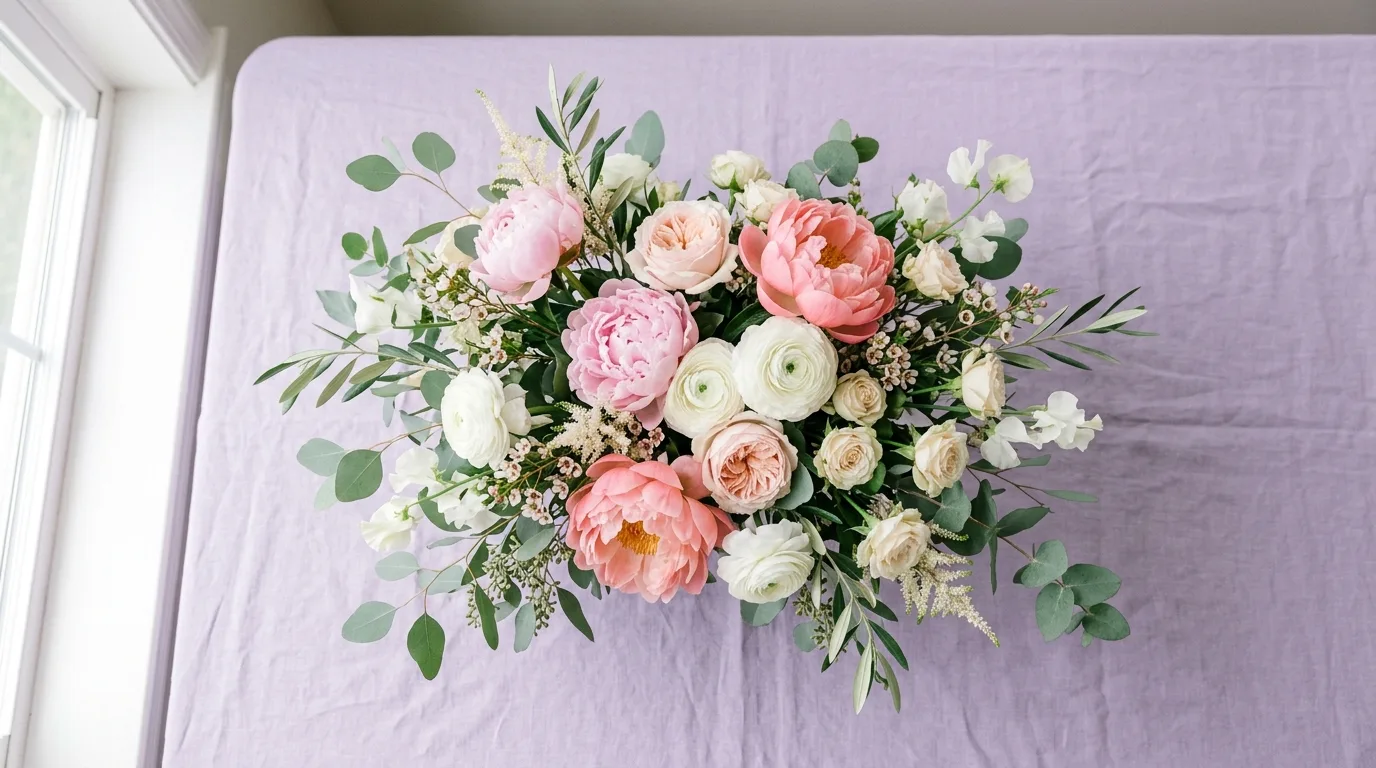
The Linear Installation: Long, low arrangements running the full length of a rectangular table rather than a single vessel in the center. This format is increasingly common for seated dinners and works particularly well for head tables or featured tables at award galas.
The Single-Stem Statement: For a company that wants to signal restraint and refinement, a single oversized stem in an architectural bud vase makes a strong editorial statement. A single black-centered anemone, a massive parrot tulip, or one stem of blush charm peony in a clear fluted vase on a mirror tile says more than an overcrowded arrangement.
Seasonal Choices for Greater Boston Corporate Events
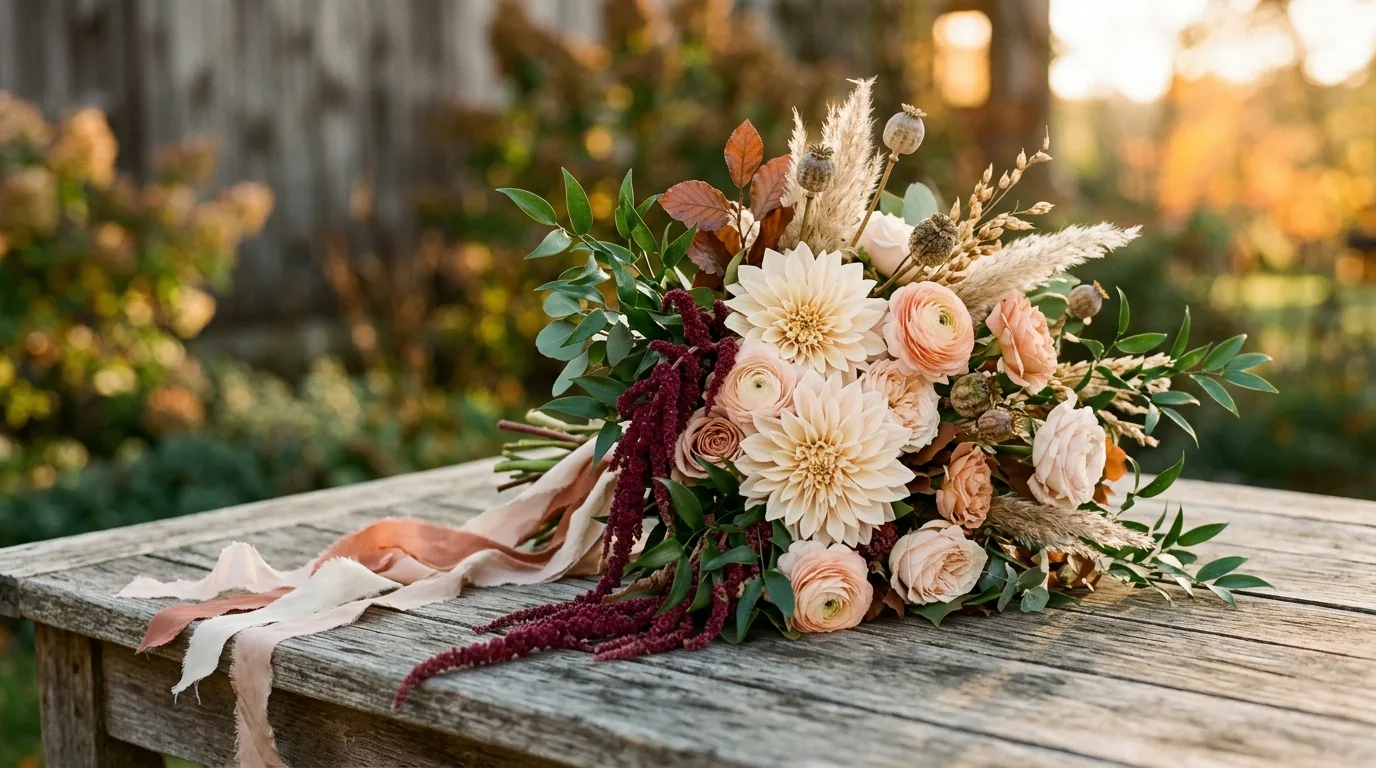
Boston's corporate gala calendar clusters in October-November and April-May. For autumn galas, dahlias are the clear choice for anchor flowers. October dahlias from Massachusetts farms are exceptional. Supplement with seasonal elements: dried amaranth, bittersweet vine, persimmon branches. The palette almost builds itself, and the result looks specific to the place and the moment.
For spring galas, ranunculus and garden roses dominate. If the event falls in late April, local tulips remain available and are underused in corporate contexts. Lilac, if available from local growers, adds fragrance and visual softness that always lands well in a gala room.
Brand Color Integration
Many corporate clients ask whether florals can incorporate their brand colors. The answer is yes, but with discipline. Flowers exist in a narrow palette of naturally occurring pigments. Trying to hit a specific Pantone color with flowers usually results in something that looks neither like the brand color nor like a natural arrangement.
The more effective approach is to suggest the brand palette rather than match it. If the brand color is a deep navy and gold, the solution is not navy-dyed flowers but rather an arrangement in deep plum, midnight purple, and champagne that evokes the same tone. For companies with neutral or black-and-white brand identities, the freedom to choose any palette is actually an opportunity to do something more interesting.
Managing Florals at Scale
Before signing a contract with a florist for a corporate event, get clear answers on delivery and setup logistics, what happens to the florals after the event, and what the contingency plan is for last-minute changes. A florist who has worked in Boston's corporate event circuit understands that attendee counts change and room layouts get revised at 72 hours out.
The florals at a corporate gala are not decoration in any trivial sense. For the guests in that room, they are part of the atmosphere of the evening. Getting them right is worth the additional attention.
January 28, 2026
Most conversations about sustainable events focus on paper straws and compostable plates. Those choices matter, but they miss the larger question: what happens to the significant resources that go into an event after it ends? For florals specifically, the standard industry model is still largely one of disposal. Arrangements are built, displayed for a few hours, and thrown away. A studio that operates with a genuine commitment to sustainability and community impact looks at that outcome and treats it as a design problem, not an inevitability.
The Waste Problem in Event Florals
A single wedding in the Greater Boston area typically consumes between 200 and 600 stems of cut flowers. Add in ceremony installations, boutonnieres, corsages, and cocktail hour florals, and the total for a mid-sized wedding can reach well above 1,000 stems. For a corporate gala with 20 tables and a stage installation, 1,500 stems is not unusual.
Under conventional industry practice, the vast majority of this material ends up in a dumpster the next morning. Venues discard flowers with the rest of the event debris. The environmental accounting is not trivial: cut flowers are resource-intensive to grow, and many commercially available stems are imported from South America, carrying a substantial carbon footprint before they ever arrive at a Boston wholesaler.
Local and Seasonal Sourcing
The most impactful sourcing decision a florist can make is to prioritize flowers grown within a short distance of the event. Eastern Massachusetts has a growing community of cut flower farms in Concord, Carlisle, Westford, and along the South Shore that supply directly to florists and farmers markets. Flowers sourced from these farms arrive fresher, require no air freight, and support the regional agricultural economy.
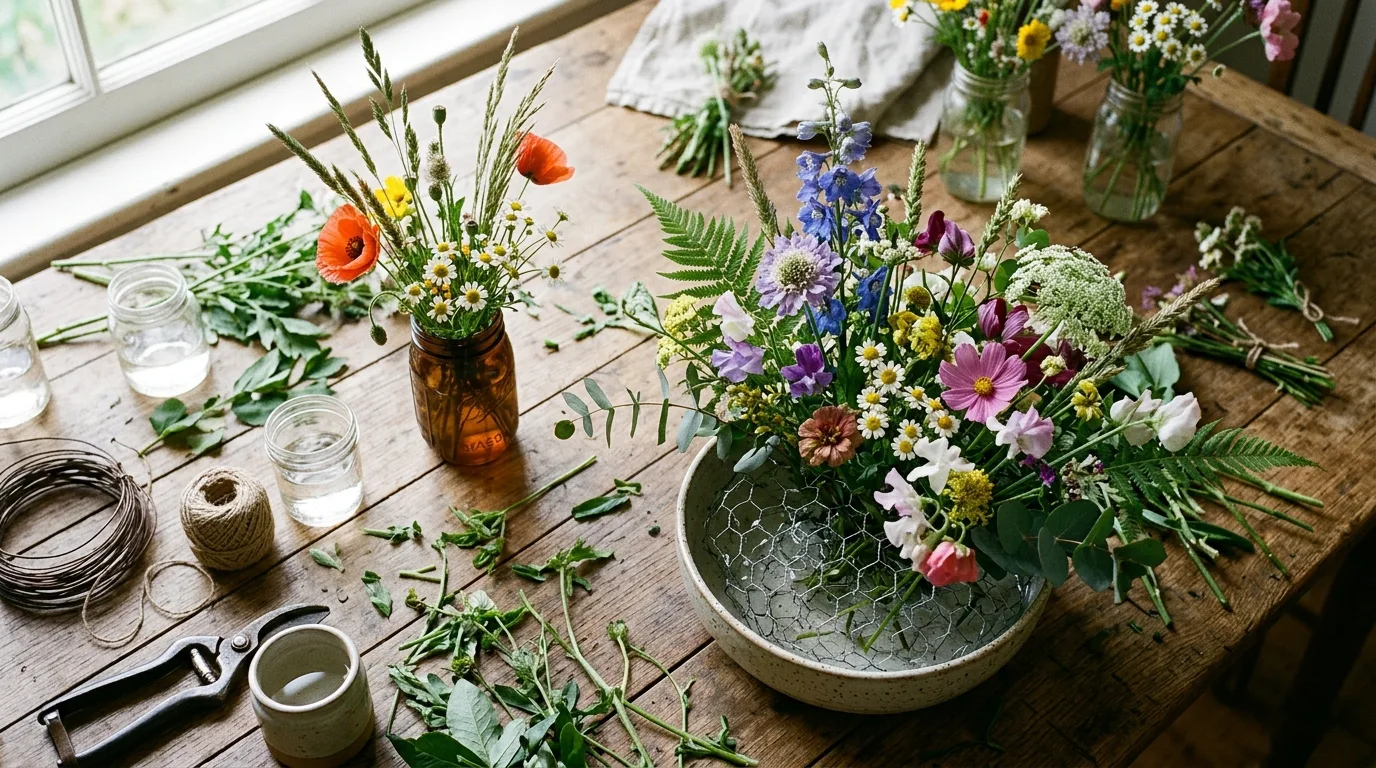
The practical tradeoff is variety. A florist committed to local sourcing has to be willing to design around what is available, not around a Pinterest board assembled without regard for season. This is actually a creative strength: arrangements built from what is genuinely in season have a specificity and freshness that imported alternatives cannot match.
Beyond sourcing, design choices that minimize waste matter. Building foam-free arrangements using water-based mechanics eliminates floral foam from the equation. Floral foam is a petroleum-based product that does not biodegrade and has been flagged by environmental researchers as a significant source of microplastic contamination.
Donation Programs: Connecting Events to Community
One of the most effective ways to extend the life of event florals is through a structured donation program. Within 24 to 48 hours of an event, arrangements in good condition are delivered to organizations that can distribute them: assisted living facilities, homeless shelters, hospice programs, community centers, and food pantries.
Organizations like Community Cooks in the Boston area, which prepares and delivers meals to people in need, operate facilities where flowers in common areas meaningfully improve the environment for both residents and staff. Room to Grow, which works with families of young children living in poverty, can receive flower donations at offices and community events.
This model has an additional benefit: it becomes part of the story the event tells. Clients who hire a studio with an active donation program can communicate that fact to their guests. A card at each table explaining that the centerpieces will be delivered the following morning to a specific organization transforms the flowers from decoration into something with a second act.
Philanthropic Business Models
Beyond post-event donation, some studios operate with a broader philanthropic commitment built into the business itself. When a studio commits 50% of profits to local nonprofits, every event it books becomes a direct mechanism for community investment. For clients who care about where their money goes, this is a meaningful differentiator.
Practical Steps for Event Planners
For planners building a more sustainable event practice: require florists to identify what percentage of stems will come from farms within 150 miles. Specify foam-free arrangements. Build a flower donation handoff into the event timeline. Ask florists directly whether they have any structured charitable giving. And for stems that cannot be donated, arrange for composting rather than general waste.
The event planning industry generates substantial waste and, when structured intentionally, substantial community benefit. The two are not in tension. A studio built around sustainable sourcing, donation programming, and charitable giving demonstrates that the highest-quality event work and meaningful community impact reinforce each other.
December 15, 2025
New England weddings live and die by the season. A bride getting married in October at a restored farmhouse in Concord is working with a completely different palette than one saying her vows in a Belmont garden in late June. Getting the flowers right means understanding not just what looks beautiful, but what is actually in season, what will hold up in the humidity of August or the chill of a November venue, and what the local growers in eastern Massachusetts can reliably supply.
Spring: Abundance Without Excess
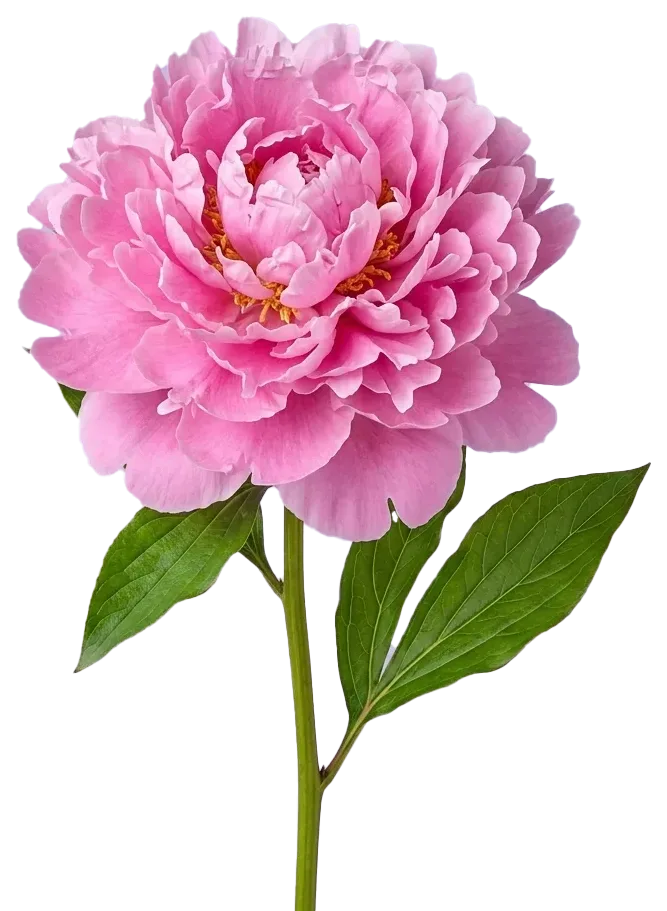
Spring weddings in New England typically fall in late April through early June. The instinct is to go full English garden, and that instinct is largely correct, but timing is everything. True New England spring arrives late. Local peonies rarely peak before late May. Brides marrying in early May who want locally sourced peonies are almost always disappointed.
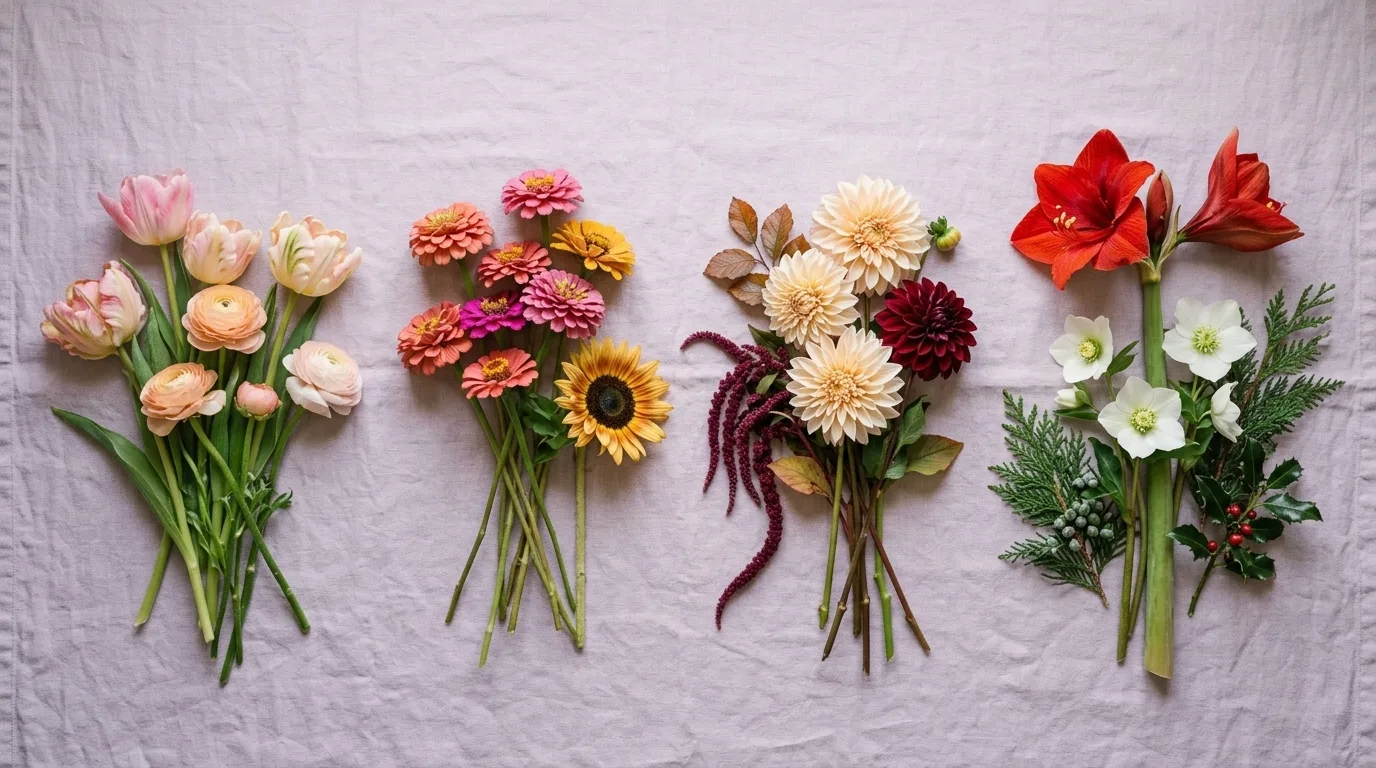
The smarter approach in early May: build around tulips and lilac. Both are genuinely in season in Massachusetts, both photograph exceptionally well, and neither needs to be forced. Lilac in particular is underused in wedding florals. It brings texture, a pale lavender-to-purple gradient, and an unmistakable fragrance that fills a room without being overwhelming. Pair lilac with cream garden roses and white sweet peas, and you have a spring arrangement grounded in what the region actually grows.
By late May and into June, ranunculus arrive in earnest. A late-May ceremony can support overflowing centerpieces in blush, peach, and soft coral. Keep the greenery restrained: Italian ruscus or eucalyptus provides structure without competing with the blooms.
Summer: Managing Heat and Humidity
Summer weddings in New England present a logistical challenge that no amount of floral talent fully eliminates: heat. By late July, daytime temperatures regularly hit the mid-80s, and venue humidity can spike dramatically. Flowers that look stunning in a studio at 9 a.m. can wilt by the cocktail hour if the choice of variety is wrong.
Florists who work primarily in the area lean heavily on heat-tolerant varieties: zinnias, sunflowers, amaranth, celosias. These are not second-choice flowers. Zinnias in mixed hues create arrangements with a warmth and energy that roses cannot replicate in the same season. They also source locally; many farms in the Pioneer Valley and along the South Shore grow cut zinnias specifically for the Boston market.
Hydrangea is a summer staple in Massachusetts, but it demands careful handling. Use it where stems remain in water as long as possible, and avoid direct sunlight. When handled correctly, it is unmatched for volume and that distinctly New England summer aesthetic.
Autumn: The Strongest Season
Autumn is the reason many couples choose New England for their wedding. The foliage, the light, the cool air. And the floral options in September and October are genuinely outstanding: dahlias peak in late summer through early October, making them the undisputed star of fall wedding florals in this region.
Dahlias reward working with a local grower. Farm-direct dahlias in late September offer varieties and colorways that wholesalers rarely carry: deep burgundy cafe au lait, dark chocolate, rich plum, bright tangerine. For an autumn wedding in a venue with exposed brick or natural wood tones, a centerpiece built around these dahlias with accents of amaranth and seasonal berries is more striking than anything achievable with imported flowers.
Beyond dahlias, fall brings persimmon branches, bittersweet vine, dried oak leaves, and late-season crabapples. The key editorial choice is restraint: autumn New England already has so much visual richness that florals should complement it, not compete.
Winter: Elegance Through Limitation
Winter weddings are rare in New England but growing. The floral challenge is that the local growing season is entirely dormant. Everything comes from wholesale sources, which means the emphasis shifts from seasonal provenance to variety and design intention.
The strongest approach is to anchor arrangements in evergreen branches and build out from there with forced amaryllis, white ranunculus, and winter white anemones. The black center of an anemone against its white petals creates a graphic contrast that reads beautifully in candlelit venues. Add in dried elements: cotton bolls, bleached seed pods, preserved eucalyptus. The result is a winter palette that feels intentional rather than apologetic about the season.
Choosing Your Florist Around These Realities
The most common mistake couples make is selecting a florist based on portfolio photos taken in a different season. A stunning all-peony bouquet photographed in June means nothing if your wedding is in September. Ask any florist you're considering to walk you through specifically what will be available and locally sourceable on your date. A studio with deep ties to eastern Massachusetts growers will give you a direct and honest answer. That answer should be the foundation of your floral plan.