Creative Centerpiece Ideas for Local Corporate Galas
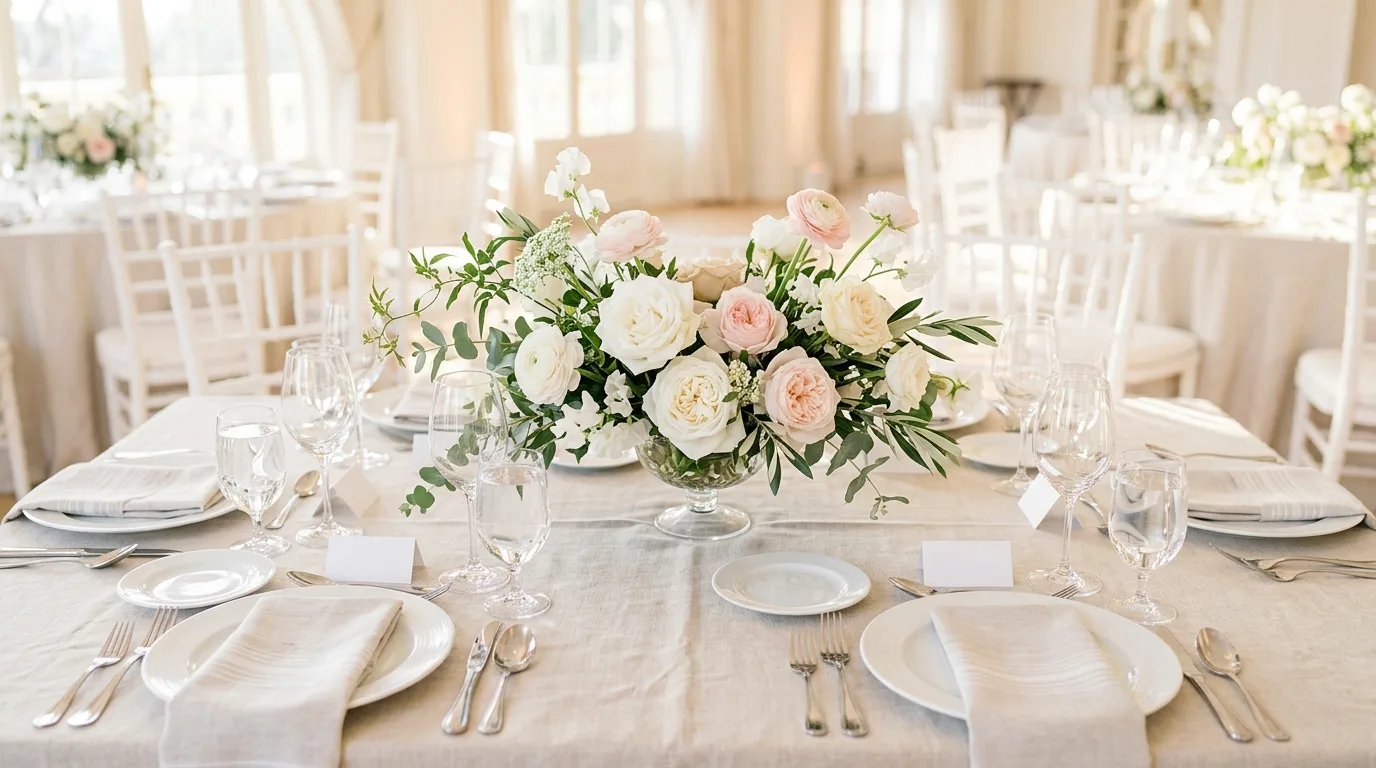
Corporate gala florals get handled badly more often than not. The event planner is focused on catering, AV, and seating charts; the florist gets a late brief, a fixed budget, and a vague instruction to "make it look nice." The result is usually a table of identical low arrangements in hotel-lobby colors that no one remembers and no one photographs. For companies that are spending real money on an event to honor clients, recognize employees, or launch an initiative, that outcome is a wasted opportunity.
Getting corporate event florals right requires a different kind of brief than a wedding -- and a different set of design decisions at the table level. Here is a practical guide to what works for Boston-area galas, what to avoid, and how to build centerpieces that serve the actual goals of the event.
Define the Room Before You Define the Arrangements
The most common mistake in corporate florals is designing arrangements in isolation without accounting for the venue. A centerpiece that works beautifully in a low-ceilinged function room at a boutique hotel will disappear in the soaring atrium of a Cambridge conference center. Before anything else, the florist needs to walk the room -- or, at minimum, review accurate floor plans and ceiling heights.
For rooms with high ceilings (above 14 feet), low arrangements read as furniture accessories rather than design statements. In these spaces, elevated centerpieces on tall clear-glass risers or wrought-iron stands bring florals into the sightline and give the room scale. Conversely, a formal dinner in a historic space with 9-foot ceilings and architectural detail -- crown molding, wainscoting, historic portraits -- calls for lower, denser arrangements that do not compete with the room itself.
Lighting is equally important. Candlelit venues favor arrangements with warm palette flowers -- blush, peach, coral, gold, cream, deep burgundy -- that catch warm light and glow. Cool LED lighting, common in modern conference facilities, tends to flatten warm florals. In those spaces, white and green arrangements, or bold single-color statements, read more crisply.
Centerpiece Formats That Work at Scale
Corporate galas typically involve 15 to 40 tables. At that scale, design decisions get multiplied: a small visual problem in one arrangement becomes a consistent problem across the room. The format choices below have proven reliable for Boston-area gala contexts.
The Column Arrangement: A tall, cylindrical vase or clear acrylic column supporting a mounded floral sphere above sightline. Flowers are typically placed in a dense dome of a single variety or two closely matched varieties -- garden roses and ranunculus, or dahlias and garden anemones. Below the column, low votive candles ring the base. This format works in virtually any venue with adequate ceiling height and is easy to execute consistently across 30 tables.
The Low Lush: Dense, overflowing arrangements in shallow compote vessels or low bowls. The key is volume -- these should feel slightly overwhelming, as if the flowers could not be contained. Mix textures aggressively: large focal flowers (peonies, garden roses, dahlias), secondary mid-size flowers (spray roses, ranunculus, stock), and textural elements (scabiosa pods, craspedia, dried grasses). For a gala with a sophisticated aesthetic, this format rewards investment in high-quality locally sourced varieties.
The Linear Installation: Long, low arrangements running the full length of a rectangular table rather than a single vessel in the center. This format is increasingly common for seated dinners at corporate events and works particularly well for head tables or featured tables at award galas. Mechanics involve multiple small vessels concealed within a continuous bed of moss, branches, and loose florals. The effect is organic and abundant without feeling cluttered.
The Single-Stem Statement: For a company that wants to signal restraint and refinement -- a law firm, a financial institution, a design studio -- a single oversized stem in an architectural bud vase makes a strong editorial statement. A single black-centered anemone, a massive parrot tulip, or one stem of blush charm peony in a clear fluted vase on a mirror tile says more than an overcrowded arrangement. This format works best when the table linen and tableware are also strong.
Seasonal Choices for Greater Boston Corporate Events
Boston's corporate gala calendar clusters in October-November (fall fundraising season) and April-May (fiscal year-end and spring recognition events). These two windows have very different floral options.
For autumn galas, dahlias are the clear choice for anchor flowers. October dahlias from Massachusetts farms -- cafe au lait, deep burgundy, dark chocolate -- are exceptional. Supplement with seasonal elements: dried amaranth, bittersweet vine, persimmon branches. The palette almost builds itself, and the result looks specific to the place and the moment.
For spring galas, ranunculus and garden roses dominate. If the event falls in late April, local tulips remain available and are underused in corporate contexts -- a low compote filled with parrot tulips in apricot and ivory is more visually interesting than standard roses and substantially less expensive. Lilac, if available from local growers, adds fragrance and visual softness that always lands well in a gala room.
Brand Color Integration
Many corporate clients ask whether florals can incorporate their brand colors. The answer is yes, but with discipline. Flowers exist in a narrow palette of naturally occurring pigments. Trying to hit a specific Pantone color with flowers usually results in something that looks neither like the brand color nor like a natural arrangement.
The more effective approach is to suggest the brand palette rather than match it. If the brand color is a deep navy and gold, the solution is not navy-dyed flowers (these look artificial and the dye bleeds) -- it is an arrangement in deep plum, midnight purple, and champagne that evokes the same tone. If the brand color is a specific green, incorporate it through foliage, succulents, and verdant textural elements rather than trying to find a flower in that exact shade.
For companies with neutral or black-and-white brand identities, the freedom to choose any palette is actually an opportunity to do something more interesting. An all-white arrangement with greenery looks clean and premium. A bold monochromatic arrangement in deep red or saturated coral makes a statement in photographs.
Managing Florals at Scale: What to Ask Your Florist
Before signing a contract with a florist for a corporate event, get clear answers on the following:
How are arrangements delivered and set? For a 30-table gala, setup logistics are non-trivial. Confirm who is responsible, what the timeline is, and how replacements are handled if an arrangement is damaged in transit.
What happens to the florals after the event? A florist with an active donation program can coordinate next-day delivery to a local nonprofit. This is not standard practice, but studios committed to community impact build it in.
What is the contingency plan for last-minute changes? Corporate events shift constantly -- attendee counts change, room layouts get revised at 72 hours out. A florist who has worked in Boston's corporate event circuit understands this and prices in flexibility. One who does not will send change-order invoices at the worst moment.
The florals at a corporate gala are not decoration in any trivial sense. For the guests in that room, they are part of the atmosphere of the evening -- one of the primary signals about how much care and intention went into the event. Getting them right is worth the additional attention.