Wedding bouquet styles and how to choose one
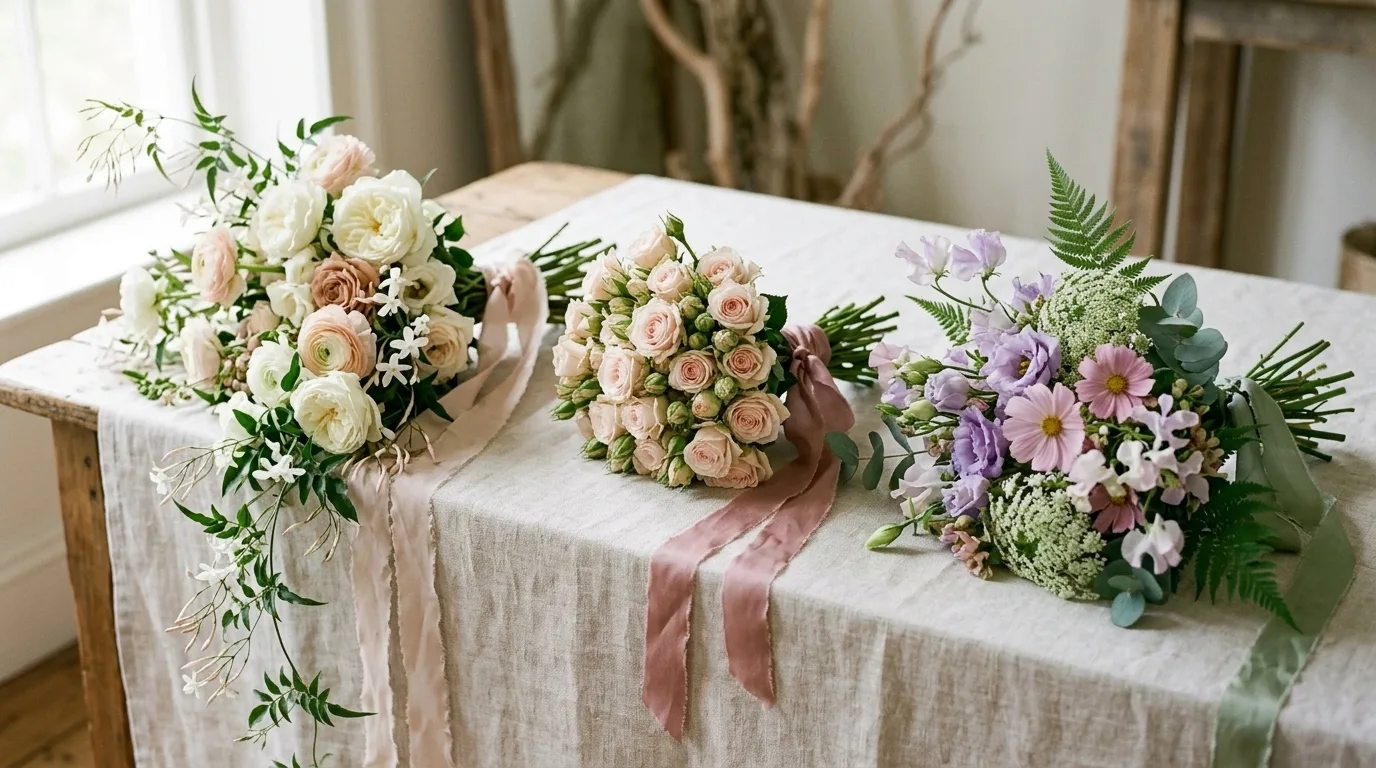
Most bouquets a florist will show you fall into a handful of shapes, and the names get used loosely enough that two people can say "garden style" and picture different things. Knowing the main shapes makes a first meeting with a florist shorter, because you can point at a category and spend the time on flowers and color. This guide covers the shapes you'll see most often in 2026, what each one asks of the flowers, and how to pick one that suits the dress, the day, and the person carrying it.
Round bouquets
A round bouquet is a compact dome of flowers, usually hand-tied with the stems wrapped in ribbon. It's the shape most people picture when they hear "bridal bouquet," and it works with almost any dress because it sits neatly at the waist without covering the bodice or the skirt. Roses, ranunculus, peonies, and lisianthus all suit a round shape, and a tightly packed version made of a single flower can look formal and modern at the same time.
A Biedermeier is a variation in which the flowers are set in concentric rings of color or variety around a central bloom. The style dates to nineteenth-century Germany and Austria, and it photographs well from above, where the rings read clearly.
Hand-tied garden bouquets
A garden bouquet is looser and less symmetrical than a round one, with flowers set at different heights, some greenery or vine trailing past the edge, and small gaps that let individual blooms read on their own. The look depends on variety, so you'll usually see focal flowers like garden roses or dahlias mixed with lighter stems such as sweet peas, cosmos, or scabiosa. Because the shape is open, it can use fewer stems than a tightly packed round bouquet of the same width, but it relies on flowers with good faces and interesting stems, and those varieties often cost more per stem.
Garden bouquets suit outdoor and less formal weddings, and they handle seasonal substitutions well. If peonies aren't available on your date, a florist can swap in garden roses or dahlias without changing the overall feel. The guide to flowers by season lists what's usually available in each part of the year.
Cascade bouquets
A cascade bouquet spills down from the hands in a trailing line, sometimes as far as the knee. Traditional cascades are built in a bouquet holder or with stems individually wired, which lets the florist control the shape but adds hours of labor. Looser modern cascades rely on naturally trailing material such as jasmine vine, amaranth, or long sprays of orchids, and they look lighter in photos.
A cascade is heavier to carry than a round bouquet with a similar number of flowers, because of the mechanics and the trailing length. If you'll be holding it through a long ceremony and an hour of portraits, ask to hold a sample before committing. Cascades suit dresses with a simple skirt, where the trailing line has room to show, and on a heavily detailed gown they can cover the parts of the dress you chose it for.
Posies and nosegays
A posy is a small, tightly gathered round bouquet, often small enough to hold in one hand. A nosegay is a similar small round bouquet that traditionally includes more greenery and is sometimes carried in a decorative holder. Both are common for bridesmaids, flower girls, and courthouse or small weddings, and they make sense when the dress or the setting should carry more of the visual weight than the flowers.
Small doesn't always mean inexpensive. A posy uses fewer stems, but a dense one still needs careful conditioning so every flower stays upright, and small premium flowers like lily of the valley are costly in any quantity.
Arm sheaf and single-stem bouquets
An arm sheaf, sometimes called a presentation bouquet, is a bundle of long stems cradled in the crook of the arm. Calla lilies, long-stemmed roses, and flowering branches suit it well. It reads as formal and a little dramatic, and it pairs naturally with a sleek column or sheath dress.
A single stem, or a small cluster of three, is the most minimal option. One oversized bloom, such as a king protea, a large garden rose, or a single peony, can look intentional and clean, and it leaves the dress and jewelry fully visible. Every bit of attention lands on one flower, so ask the florist to hand-select the stem and keep a spare in water in case the first one bruises.
Other shapes you may see
Pomanders are spheres of flowers hung from a ribbon, usually carried by flower girls. Hoop bouquets set a small asymmetric arrangement on a metal or wooden ring, a shape that became popular in the late 2010s. Composite bouquets are made by wiring individual petals together into what looks like one enormous flower, and they're among the most labor-intensive pieces a florist makes. Dried and preserved bouquets can last for years if they're kept out of sun and humidity, and they don't wilt in heat, though they lack the softness and scent of fresh stems.
Matching a bouquet to the dress and the day
Proportion matters more than any single style rule. As a rough check, a bouquet that's wider than the hips of the person holding it will hide much of the dress in photos, and one that's very small can look lost against a full skirt. Hold it low, around the navel, with relaxed arms. Large, full bouquets suit full skirts and big rooms, while slim silhouettes and small venues tend to look better with a smaller round, a posy, or a single stem.
Season and weather matter too. A summer ceremony outdoors is hard on hydrangeas, gardenias, and sweet peas, which wilt or brown quickly in heat, while zinnias, lisianthus, and many orchids hold up better. The season-by-season article on New England wedding flowers shows how this plays out in a climate with a short growing season.
Think about the hours, too. A bouquet is carried through the ceremony, held in portraits, set down at the reception, and sometimes tossed, so ask for a smaller toss bouquet if you want to keep the main one. Most hand-tied bouquets are delivered in water and should go back into a vase whenever they aren't being held, and the guide to making cut flowers last covers how to keep yours fresh through the evening and after.
How the shape affects the price
Bouquet style changes the price through stem count and labor. Wired cascades, composite flowers, and dense rounds made of small blooms take the most time, while a loose hand-tied bouquet takes less time but may lean on pricier focal varieties. When you compare quotes, ask how many stems and which varieties each bouquet includes. The guide to budgeting for wedding flowers explains the other costs that sit around the bouquets, and the questions to ask a wedding florist cover what to settle before you sign.