Questions to ask a wedding florist before you book
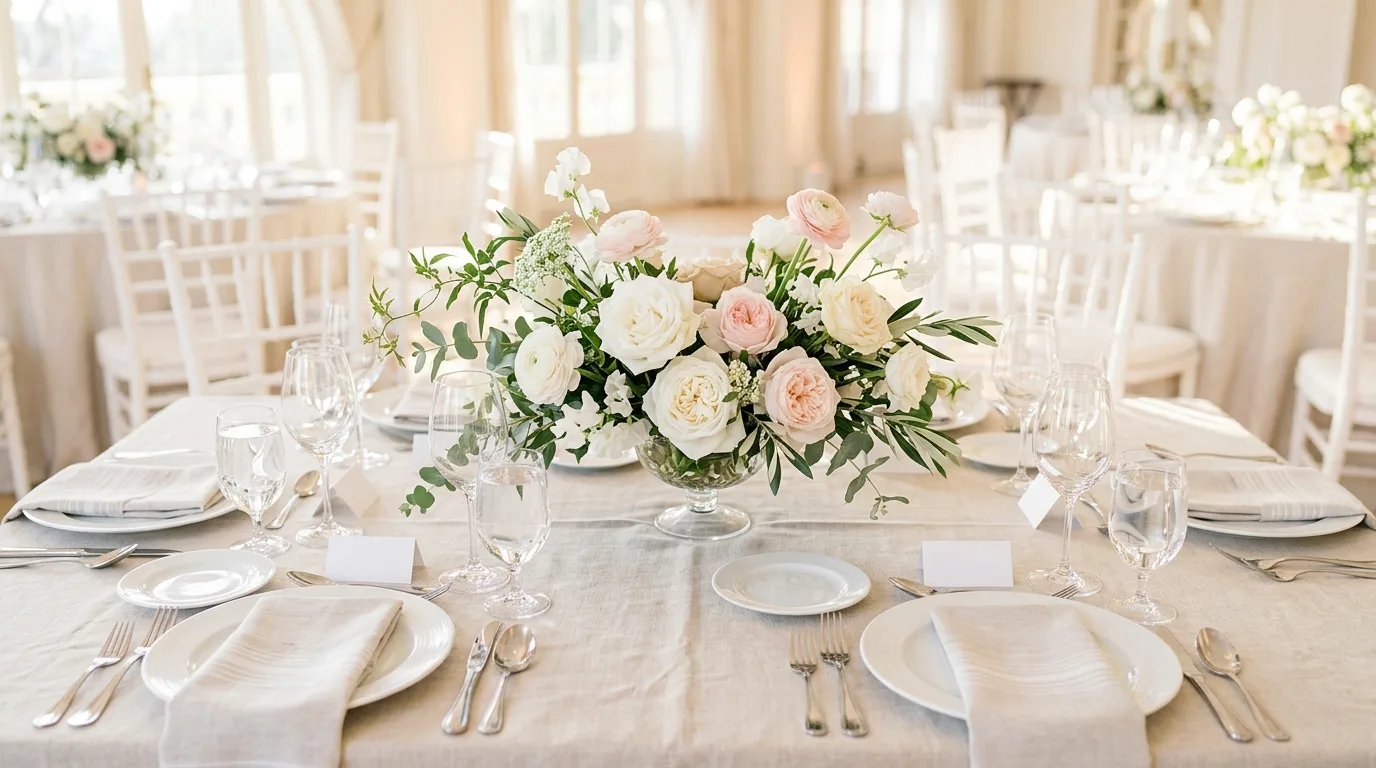
A first meeting with a florist goes better when you arrive with facts and leave with answers in writing. Florists design from a date, a place, a guest count, and a budget, so the more of those you can share, the more useful the conversation becomes. The questions below are grouped by topic, and most of them apply to galas and other large events too.
What to bring to the first meeting
Bring the date, the ceremony and reception venues, your estimated guest count and table count, and a realistic budget range. Photos help, especially if you include a few you dislike, since knowing what to avoid narrows the choices quickly. A picture of the dress, the attendants' colors, and the venue's interior gives the florist the background the flowers will sit against.
Availability and experience
Start with the basics. Ask whether they're available on your date and how many events they take that day or weekend, since a florist covering several weddings will rely more on staff for setup. Ask whether they've worked at your venue. A florist who knows the building will already know its load-in route, its rules on open flames and loose petals, and the time the room has to be cleared.
Ask to see complete galleries from real weddings, ideally in your season. Portfolio highlights are usually the strongest single shots, and a full set shows how consistent the work is across bouquets, boutonnieres, and thirty centerpieces. A peony-heavy June gallery won't tell you much if you're marrying in October, a point the article on seasonal wedding flowers makes in detail.
Flowers, seasons, and substitutions
Ask what will be in season on your date and what they'd suggest building around. Then ask how they handle substitutions. Flowers are a crop, and weather or supply problems sometimes leave a variety unavailable or poor in quality the week of the wedding. Contracts commonly let the florist substitute a flower of similar color, style, and value, and some couples ask to be told in advance if a focal flower has to change. The guide to flowers by season gives you a starting point before the meeting.
If sustainability matters to you, ask about mechanics and sourcing. Many florists now design without floral foam, using chicken wire, flower frogs, and water-filled vessels, and some can tell you which stems will come from local farms. The guide to sustainable event planning covers what to ask in more depth.
What the quote covers
Ask for an itemized proposal and go through it line by line. Check whether delivery, setup, breakdown, rentals, taxes, and service fees are included, and whether vases and stands are rented or yours to keep. Ask when the final guest and table counts are due, how much you can change after signing, and what happens to the price if the count drops. The guide to budgeting for wedding flowers explains which line items tend to move the total most.
Ask about the deposit and payment schedule, and read the cancellation and postponement terms closely. Many florists take a nonrefundable retainer to hold the date, because they turn away other work once you've booked.
Check the proposal against your list
Before you sign, lay the proposal next to the list of pieces you asked for and confirm that each one appears with a count. Then find the delivery, setup, breakdown, and rental lines, the substitution clause, and the date your final numbers are due. Anything you discussed in the meeting that you can't find on the page should be added in writing.
The day itself
Ask who will be on site, what time they'll arrive, and how long setup takes. Confirm when personal flowers will be delivered, where they'll go if the wedding party is getting ready in two places, and whether someone will pin boutonnieres. If ceremony pieces are moving to the reception, ask who moves them and when.
Venues often require vendors to carry liability insurance and to send a certificate before the event, so ask the florist to confirm they can provide one. Ask, too, what happens after the last dance. Some florists collect rentals that night, some return the next morning, and some let guests take centerpieces home when the vases aren't rented.
Seeing a sample
Some florists offer a mock-up of a centerpiece or bouquet, usually for a fee and usually a few months before the date. A mock-up lets you check height, scale, and color against your actual linens, and it's worth asking for if your reception has many tables or a strong design. Sitting down at a table with the sample tells you more than any photo, which the guide to centerpiece height and sightlines explains.